
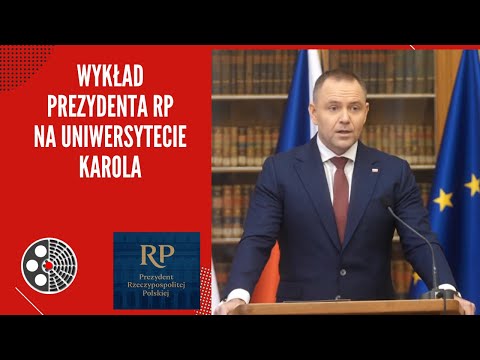

Prezydent broni suwerenności i krytykuje centralizację UE
Prezydent wygłosił wykład na Uniwersytecie Karola w Pradze, w którym krytycznie odniósł się do projektu centralizacji Unii Europejskiej i bronił suwerenności państw członkowskich. Przedstawił też polski program wobec UE, podkreślając konieczność wsparcia Ukrainy oraz walki z korupcją.
Prezydent zaznaczył, że Unia Europejska jest naturalnym środowiskiem politycznym, ale „nie jest to unia naszych marzeń”. Wyraził sprzeciw wobec federalizacji używanej jako kamuflaż do pozbawiania państw suwerenności oraz możliwości decydowania o własnych systemach politycznych i wychowaniu dzieci.
Z godnie z wykładem, „mistrzami traktatów” i suwerenami decydującymi o kształcie integracji muszą pozostać państwa członkowskie. Prezydent podkreślił, że bez europejskiego demos nie ma demokracji, dlatego w jego wizji jedynymi suwerenami pozostają narody i ich wybrane władze.
Prezydent ocenił, że Komisja Europejska i powiązane instytucje bywają nie reprezentatywne i działają według kryteriów ideologicznych. Zaznaczył, że Polska nie jest wrogiem Unii, lecz prezentuje odmienną wizję polityczną i ma prawo dążyć do jej realizacji.
Wykład wskazywał na odrodzone neoimperialne zapędy Rosji jako zagrożenie egzystencjalne. Prezydent przypomniał, że Ukraina walczy z zewnętrznym agresorem i wewnętrzną korupcją i wyraził nadzieję na zwycięstwo w obu tych starciach.
Odwołał się do historycznych doświadczeń regionu i stwierdził, że zjawisko korupcji można skutecznie powstrzymać — kraje Europy Środkowej na drodze do instytucji euroatlantyckich dowiodły, że jest to wykonalne. Wskazał także korzyści gospodarcze z członkostwa w UE oraz znaczenie strefy Schengen.
Główne tezy wykładu
Prezydent zaznaczył, że Unia Europejska jest naturalnym środowiskiem politycznym, ale „nie jest to unia naszych marzeń”. Wyraził sprzeciw wobec federalizacji używanej jako kamuflaż do pozbawiania państw suwerenności oraz możliwości decydowania o własnych systemach politycznych i wychowaniu dzieci.
Suwerenność i rola państw członkowskich
Z godnie z wykładem, „mistrzami traktatów” i suwerenami decydującymi o kształcie integracji muszą pozostać państwa członkowskie. Prezydent podkreślił, że bez europejskiego demos nie ma demokracji, dlatego w jego wizji jedynymi suwerenami pozostają narody i ich wybrane władze.
Ocena instytucji unijnych
Prezydent ocenił, że Komisja Europejska i powiązane instytucje bywają nie reprezentatywne i działają według kryteriów ideologicznych. Zaznaczył, że Polska nie jest wrogiem Unii, lecz prezentuje odmienną wizję polityczną i ma prawo dążyć do jej realizacji.
Polityka wobec Rosji i wsparcie dla Ukrainy
Wykład wskazywał na odrodzone neoimperialne zapędy Rosji jako zagrożenie egzystencjalne. Prezydent przypomniał, że Ukraina walczy z zewnętrznym agresorem i wewnętrzną korupcją i wyraził nadzieję na zwycięstwo w obu tych starciach.
Historia i walka z korupcją
Odwołał się do historycznych doświadczeń regionu i stwierdził, że zjawisko korupcji można skutecznie powstrzymać — kraje Europy Środkowej na drodze do instytucji euroatlantyckich dowiodły, że jest to wykonalne. Wskazał także korzyści gospodarcze z członkostwa w UE oraz znaczenie strefy Schengen.
Udostępniamy tysiące materiałów, by polityka była przejrzysta i odporna na manipulacje. Widzisz błąd? Zgłoś go — razem budujemy rzetelne archiwum polskiej polityki.
Inne wystąpienia
Tego samego dnia Wszystkie wystąpienia z tego dnia →
Waldemar Żurek
Waldemar Żurek o wątpliwościach wokół wyboru prezydenta
Dorota Olko
[Lewica]: Młody pracownik to nie niewolnik
Sejm RP
Wojciech Szaląg otwiera konferencję o zdrowiu jako inwestycji
Koalicja Obywatelska
A. Halicki: Akty dywersji i krytyka polityki bezpieczeństwa
Monika Wielichowska
Sejm. M. Wielichowska - 36 lat reformy samorządowej
Władysław Kosiniak-Kamysz
Władysław Kosiniak-Kamysz: Podziękował Francji i omówił bezpieczeństwo
Artykuły

Transkrypcja
Szanowni Rektor, profesorzy, mężczyźni z wielu fakultów, ambasadowie, excellency, chiefs of diplomatic mission tutaj w Prague, ladies and gentlemen. Byłem wciąż newly elected president of the Republic of Poland and a historian by education. I could not be more privileged to be delivering this speech in the famous Charles University as the oldest university in our part of Europe founded in 1348 with Poland's Jagiellonian University established in 1364 a second in our region it stands as a testament of our cultural, scientific and historical attachment to Western Europe. especially taking into consideration that the oldest university in our common neighbour was created in 1386 in Heidelberg. It is also proof that the heritage of Central Europe including our understanding of how the European integration should be manifested positions us not as students in the School of European Integration who can be enlightened by those older and more experienced. We have experienced it however throughout our history. let me just recall one example of how the democratic political system of then Czechoslovakia between 1918 and 1939 was tragically ended through professional guidance of the Western world in the Munich agreement of 1948. Ladies and gentlemen some might say that today our region faces yet again similar challenges and yet again our certain Western partners try to guide us in the one and only right direction. Ukraine and its armed forces have been fighting an existential battle against a barbaric aggressor the Russian Federation for almost four years now. This is their outside enemy but they have an enemy inside too namely the internal front against the corrupted allies. I sincerely hope they will win both battles primarily because both victories are achievable. History has shown us that Russia be it Tsarist, Bolshevik or Soviet cannot only be stopped but also defeated. And every time it was defeated it brought a wave of political changes to the system. We witness it after the Crimean War in the middle of the 19th century the Russo-Japanese War at the beginning of the 20th century the First World War and the Polish-Polshevik War in its aftermath and the Soviet-Afghan War in the 1980s. Political history of our region has also shown that the phenomenon of corruption can be stopped and stopped for good. Countries of the region have had to get rid of it completely on our path to Euro-Atlantic institutions. I am proud to say that we have managed it successfully in Poland and in East Central Europe. Nevertheless, it does not mean that these institutions are ideal. Today I would like to share with you my take on our own challenges both internal and external. As for the external ones they are existential. The reborn Russian neo-imperialism. The internal ones however may not necessarily be in plain sight. Ladies and gentlemen at first let me stress the European Union is our natural political environment. But let us be clear about one thing this is not the union of our dreams. We joined the European Union which was supposed to provide us with economic opportunities and it did. It also gave us a chance to unleash our entrepreneurial potential. We joined the EU to benefit from the Schengen area and we are taking advantage of it. However, the goal was not for the European Union to dictate the terms of our political system, our diet or our upbringing of our children. There are certain forces at play that aim at creating a more centralized European Union with federalization used as a camouflage to hide the process. Its essence is to deprive member states excluding two largest of their sovereignty, downgrade their national democracies by being able to outvote them at the EU level thereby taking away their role as masters of the treaties. Abolish the principle that the EU has only those competences that the member states have granted in the treaties. And for the EU to grant itself competences by establishing the superiority of EU institutions over the sovereignty of member states. Contrary to popular belief, Poland, including the conservative camp to which I proudly belong, is not the enemy of the European Union. We merely oppose the currently dominant political ideals. And just like in any democracy, the opposition is not an enemy of the state, but rather a representative of a program and a political line different from the dominant one. As a consequence, Poland, like every member state, has its own vision of the EU and is entitled to it. It has the right to strive for the manifestation and adoption of that vision. This is, ladies and gentlemen, the nature of the democracy. Poland has centuries-long experience of operating within a union. We know the weaknesses and threats of such structures, the greatness of which is the will of stronger partners to dominate weaker ones. Therefore, we advocate for the rejection of the project of EU centralization. In matters concerning our political system and the future of Europe, it is presidents, governments, and parliaments that have a true democratic mandate obtained through free elections, not the European Commission and its subordinate institutions, which are unrepresentative of the diversity of European political currents and composed according to ideological criteria. Ladies and gentlemen, we are not groundless. We do not just offer a negative message about what we believe is wrong. We do not only complain. We have a positive message to offer. A Polish program for the European Union, the main assumptions of which I would like to now briefly present. The starting point consists of two fundamental premises. The masters of the treaties and the sovereigns deciding on the shape of European integration are and must remain the member states. as the only functioning European democracies. There is no European demos. Its existence cannot be decreed or codified and without a demos, there is no democracy. In the Polish vision of the EU, the only sovereigns remain nation states. Demons understood as communities of citizens, of individual EU member states. Modern nations are not tribes torn by atavistic passions for domination over others, as the EU mainstream tries to portray them, but nations with millennia-old traditions, culture and interests. Attempting to eliminate them, as European centralists would have it, will only lead to conflict and misfortune. Considering the existence of nations and their sovereign states as an evil that must be overcome, is another form of a utopian program. It wasn't nations that provoke two world wars, but unbridled imperial appetites of various provenances, including national ones, of course German and Russian. However, wars also broke out not because of national ambition. It is difficult to portray the Habsburg monarchy as nationalistic. Equally so, the imperialist, atheistic, anti-civilizational and, undoubtedly, anti-national communists, also started wars and led to disasters. The second premise. Poles are among the oldest European demons. We were among the first to cease being just an ethnic nation, originating from a common tribal core or a collection of subjects of the same king to become a collection of citizens of our own republic. This Republika was a country that the ancestors of today's Poland shared the principles of free with the free, equal with the equal, with the ancestors of today's Lithuanians, Belarusians, Ukrainians and the Jews. Poles also have the experience of 123 years of the Polish demons living and operating despite the non-existence of its statehood. The notion, then, that we would somehow dissolve into a vague European identity, subject to authorities and laws over which we will essentially have no influence, outvoted by the powers that be, dominated by the currently projected centralized EU system and living under foreign hegemony, is a utopia detached from reality. As such, having those in mind in order to stop and consequently reverse this negative trajectory of the process of EU centralization, Poland proposes the following actions. First, maintaining the principles of unanimity in those areas of EU decision making, where it currently applies. Second, maintaining the one state, one commissioner principle in the formation of the European Commission, whereby each EU country, even the smallest, must have its own designated commissioner in the EU's highest administrative body and at the same time prohibiting the appointment to the highest EU positions of persons without the recommendation of their home country's government. Third, the restoration of the presidency to the head of the executive branch of government of the member state holding the EU presidency at the moment, which means the return to the pre-Lisbon presidency's nature. As such, Poland also proposes the abolition of the position of president of the European Council. The president of the council has to be as before the president, prime minister or chancellor of his or her country. That is a politician with a democratic mandate and political base rather than a bureaucrat official dependent on the support of the EU's greatest powers. While the rotation of this position gave each member state a periodic dominant influence on the functioning of the European Council, the current system ensures the permanent dominance of the EU's central powers and marginalizes the others. The same applies to the EU Council for Foreign Policy, which is headed by an official dependent on the great powers and not by the Minister of Foreign Affairs of the country holding the presidency, who has a democratic mandate. Fourth, basing the voting system in the EU Council in such a way as to eliminate the excessive advantage of large EU countries, to maintain the support of smaller nations for the process of European integration. These nations must have a real influence on decisions. Fifth, basing the functioning of the EU on pragmatic principles, without ideological pressures, limiting the competences of EU institutions to selected non-ideological areas or challenges such as economic development or demographic collapse, thereby reducing the areas of competence of European institutions to those where the chances of being effective are real substantial. This means abandoning excessive ambitions to regulate the entire lives of member states and its citizens and the intention of shaping all aspects of politics, sometimes by bypassing or violating the will of the citizens. Next, in terms of geopolitics, stopping the ambition to compete with NATO in the security dimension. Over the past three or so decades, the EU's security policy has not shown effectiveness. In the face of the post-Yugoslav wars, the destabilization in North Africa and the Middle East, or the Russian aggression against Georgia and Ukraine. The current attempt to centralize arms programs within the EU actually serves the interests of the German and French arms industries, directing money from the EU's joint debt to them, delaying delivery deadlines, disregarding the urgent arms needs of the EU and NATO's eastern flank, and providing the European Commission with yet another instrument for disciplining member states. Furthermore, rejecting the European Commission's regulation, so the Digital Services Act. The idea of any censorship is alien to Polish political culture. Already in the late 16th century, Grand Chancellor of the Crown the Crown and Grand Headman of the Crown Jan Zamoyski, when asked by Moscow's and voice of Ivan the Terrible to burn books that portrayed the Kremlin ruler in a negative light, replied, We here in this Commonwealth neither prohibit nor order the writing of any books. This is a shared tradition of the Polish-Lituenian Commonwealth and the Czech Republic. It is not without reason that Franciszek Skoryna, today a symbol of a great Renaissance man for Bielorussians printed his first Bible in the world written in the Cyrillic alphabet in the old Bielorussian language here in Prague in 1517 and his other works in Vilnius, the capital on the Grand Duchy of Lithuania. And finally, rejecting the mainstream division of the EU political scene into, on the one hand, the enlightened supporters of the constantly deepening integration and on the other, to primitive populists with totalitarian tendencies. The notion that this is the division line of EU's political scene is ridiculous, ladies and gentlemen. It's divided into the camp of continuity and reform. Since the current system has led us to debt, uncontrolled migration, energy crises, provoked Brexit and exposed us to Russian imperialists, financed for years by the EU core, change is a necessity. The Euro-skepticism, therefore, stemmed from the mistakes of the EU mainstream and its undemocratic nature. Ladies and gentlemen, this is, in a nutshell, my vision of which direction the EU should be headed. One may wonder now, is this possible? There should be no illusion about the chances of these ideas being adopted by the EU. However, submitting such comprehensive programs for improving our union is the right of every member state. Let me be crystal clear. I am a supporter of Poland in the European Union. But I believe that issues such as political and justice systems or security are reserved exclusively for the Polish Constitution, the Polish President and the Polish government. Just as they should be for every member state. I understand my role as the President of the Republic of Poland not as someone who questions the presence in the European Union, but as a leader who, based on the countries of the region, our sensitivity and emotions will build a stronger Central Europe within the European Union. If any of you find this vision acceptable, and frankly speaking close to your political heart, I am more than willing to continue the conversation. As of now, let it serve as food for thought. Thank you very much for your attention. Thank you very much, Mr. President. Thank you for your lecture. Thank you for your speech. Now there is time for your questions. There is time for discussion. Just please, yes, let me know that you want to speak. You will be given a microphone. And please keep it in English, if I may ask. Right? Thank you. Thank you, Mr. President. I am a very proud Polish person that you are here as a doctoral student at Charles University. It is a great honor for me to be here. And my question is very simple. We can see, of course, that Poland is important and is a key leader now when Russia is in a huge power attacking Ukraine. And I think, as you said, European Union, we are all proud to be a member of it. But at the same time, European Union doesn't really see our role. And what I can see from the point of view of being abroad is that the United States is in much more support to us, being so far, versus to European Union, that we are part of it, and ultimately it's a higher risk for all of our members. And my question is what we can do and how possibly we can change the narration that European Union would say, well, yes, Poland is important because it's kind of a border and only Poland can stop the Russian imperialism for the future risk. How we can do that? And what is your role and what is your plan for that? And thank you. And please excuse me. Dziękuję, panie prezydencie. Bardzo dziękuję. Madame Rektor mentioned that here in Charles University we have more than 100 Polish students. Madame Rektor has more than 100 Polish students, exactly 103. So it's very nice to meet Polish students here at Charles University. Thank you for your voice. I think that my role is to do everything to increase the Polish finances for military service. So as the head of the Polish military service, I am responsible for this project. We are the first country in United Europe because we have 4.7 GDP spendings on the military service. So it's very important to build the responsibility inside the states. And it's the very big breakthrough happened in HAC Summit when many countries declared that try to achieve 5% spending of GDP. So this is the first step. I think we should carry about our own nations and our military services. It's most important. Second one. So this is the reason that I'm here in Prague, in Czech Republic. And I was in Slovakia. I'm going to Hungary for the V4 group meeting. It's very important to build those formats which are indispensable for our security. It means FreeSys Initiative, Visegrad Group, our cooperation with Baltic states and with Scandinavian states to encourage West Europe to look at East and Central Europe as someone who has many ideas about the very important issues in security and economy. During my meetings with the President from the West, with Chancellor Mertz, with President Macron, I also during the discussion as the pro-European politician tried to convince them that they have made so many mistakes according to the immigrants issues, Green Deal issues, climate issues. We don't want to be in East Central Europe a part of those mistakes. We would like to build the responsibility, security responsibility and build our future without those mistakes. So thank you for your voice. I think this is my main mission to be the voice of Poland and the voice of East Central European countries with my partners. Thank you, sir. Next question goes to the lady over there. Thank you. Good afternoon, Mr. President. I wanted to ask you a question which is a bit different from the topic we talked about right now. I'm a student here of Polish language and we wanted to ask you do you think the current relations between Poland and Ukraine are influenced by their common history and how? Yes, I am 100% sure that those relations are touched by our common history because we would like to bury the victims of the Volhynian massacre. We are responsible. I am, like the President, as the President of the Republic of Poland, responsible to bury 120,000 people, children, women who were killed by Ukrainian nationalists. So I think that the history is one of the points in relations between our nations. But, of course, we support Ukraine. We have supported Ukraine till 2022. We are open. And we understand the strategic aim, strategic goal of Poland and all Central Europe. So we still support Ukraine. But we would like to be treated by Ukrainians as partners. We are partners. We are partners who help. And we are partners who have also our points on the list of challenges. So I think that history is also important. We have great diplomats here, ladies and gentlemen. And I think that every diplomat, every ambassador can approve it, that the history is a part of diplomacy. Not only between Poland and Ukraine, but between all countries all over the world. Thank you very much, ladies and gentlemen. I've just been informed that the time's up. Sorry to inform you about that. No more time for any further questions. Many thanks for coming. Mr. President, thank you once again for your lecture. Thank you, professors. Madame Rector, thank you very much. And please, everybody, remain seated until Mr. President leaves the premises. So stay where you are, please. Remain seated for a while.